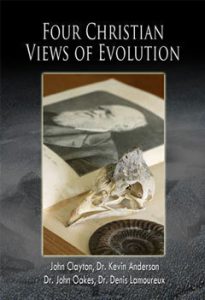
A friend is having a hard time reconciling their belief in evolution with Christianity. What books on this topic can you recommend?
Question:
I have a friend who is having a hard time reconciling their belief in evolution with Christianity–particularly with God creating the world in 6 days and that Adam and Eve were the first humans to exist. What books can I recommend them to read that will help them navigate this argument?
Answer:
Let me tell you that I, for one, as a PhD scientist and chemistry professor, and also as a faithful, Bible-believing disciple of Jesus, have no problem with the theory of evolution. It is my opinion that neither should any believer have a problem with the theory of evolution. The Bible gives God the credit for creating everything, including the galaxies, stars and planets, as well as the different species. But he did not specify the mechanism he used. We can gain insight into the “how” of creation by looking at his creation–nature! God invented evolution, so we, as believers, should thank him and give credit to him for this remarkable means of change of species over time.
The bottom line with regard to the origin of species is that the only successful working scientific theory/model to explain the available data of both the fossil record and the genetics of species is that there has been change in species over great periods of time, through a process which we have called evolution. Not only that, but on a very small scale, what some call “microevolution” has been observed in viruses, bacteria and other simple organisms. Evolution on a small scale has been demonstrated in the scientific laboratory and in the field.
The potential problem between the successful scientific theory of evolution and Christianity arises if one assumes (note the word assumes) that the six days of creation must be taken as literal 24-hour periods. I do not take these days as literal. Neither do a majority of Bible-believing Christians, but there are some (actually, many) who make it a matter of faith to assume a fully literal interpretation of the days of Genesis 1. If we do so, then we do come up against some evidence for a great age of the earth, as well as evidence in the genetics and in the fossil record which appears rather strongly to be in contradiction to this assumption.
People will need to work out this problem for themselves, but if we assume that the earth is only quite young–at most several thousand years old, then there are a number of apparent facts which must be reconciled, for example that we can observe galaxies which are one billion light-years distant from us, from which the light must have been traversing toward us for one billion years. And then there is the fossil record, which shows unambiguous evidence of deep time. This appearance of age is a fact. Actual age may not be a fact (see below), but the appearance of age is. Full stop.
The young-earth literalist may “save” his or her position by proposing that God created the universe with an “appearance of age.” As a believer in an all-powerful God, I am prepared to accept this as not being a ridiculous proposal, but those making such a proposal would then need to accept that, although the universe is very young, it does at least appear to be very old. Why would God do this? That is the crux of the matter.
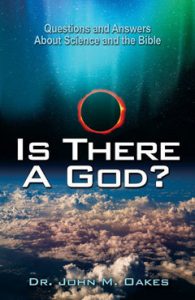
Fortunately, I have published an entire book on this topic, titled “Is There A God?” It is available at www.ipibooks.com Please order a copy and give it a look. I think it will provide some clarity on this topic for you.
John Oakes